
1. Top 5 Tokenized Real Estate Platforms Compared
Not all tokenized real estate platforms are created equal. Here's how the top 5 stack up on fees, minimums, and features:
| Platform | Minimum Investment | Platform Fees | Liquidity | Best For |
|---|---|---|---|---|
| E-Estate | $10 | 1% transparent | Sell anytime | Beginners, small investors |
| RealT | $50 | No platform fee (blockchain gas fees apply) | Secondary market | Crypto-native investors |
| Lofty | $50 | 12% of rental income | Limited secondary | Hands-off income seekers |
| Fundrise | $10 | 1% annual + 0.85% advisory | Quarterly redemptions | REIT-style diversification |
| Arrived | $100 | 1% annual management | 5-7 year hold minimum | Long-term appreciation plays |
Key Takeaway: E-Estate offers the lowest entry point ($10) with full liquidity—perfect for testing the waters before committing larger amounts.
2. How to Evaluate a Tokenized Property (3-Step Framework)
Before investing in any tokenized property, run it through this simple 3-step framework:
- Location: Is the property in a growing market? Check population trends, job growth, and new development.
- Rental Yield: Target 6-10% annual yield for residential, 8-12% for commercial. Lower yields mean you're betting on appreciation.
- Occupancy Rate: Aim for 95%+ historical occupancy. Vacant properties don't generate income.
- Property Condition: Newer builds = lower maintenance costs. Older properties = higher cap rates but more risk.
- Total Supply: How many tokens exist? More tokens = smaller share of income per token.
- Income Distribution: How often are rental payments distributed? Daily, weekly, monthly?
- Platform Fees: What percentage does the platform take? E-Estate's 1% is transparent; some platforms bury fees in "management costs."
- Exit Strategy: Can you sell anytime? Or are you locked in for years?
- Property Management: Who handles tenants, maintenance, and collections? Verify they're licensed and insured.
- Market Risk: What happens if property values drop 20%? You still own the same % of income, but liquidity suffers.
- Platform Risk: Is the platform regulated? Do they have insurance? What's their track record?
- Diversification: Don't put all your capital in one property. Spread across 5-10 properties minimum.
3. Martin McLean Case Study: $2.4M in Sales
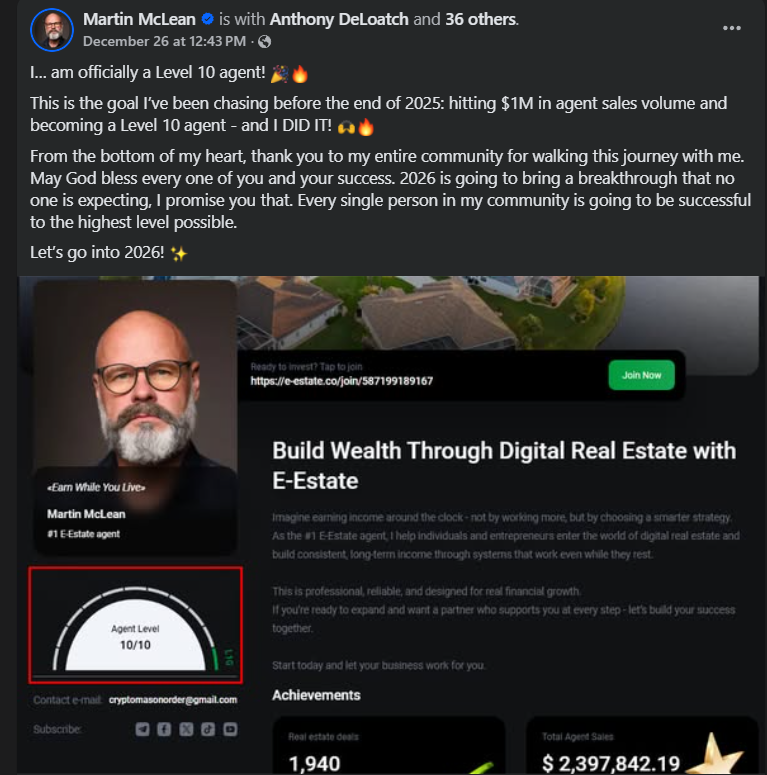
Martin McLean didn't start with capital, connections, or a real estate license. He started with curiosity about tokenized real estate and a willingness to share what he learned.
How He Did It:
- Started Small: Martin invested his first $10 in a tokenized property to understand the platform from an investor's perspective.
- Educated His Audience: Instead of "selling," he shared case studies, platform comparisons, and real returns from his portfolio.
- Built in Public: He shared his agent dashboard milestones ($100k, $500k, $1M) to build social proof and credibility.
- Leveraged Compounding: Early referrals reinvested their income, generating repeat commissions. His network grew exponentially.
- Focused on Volume: 1,940 deals weren't all $10. He attracted small investors who later scaled to $500-$5,000 investments.
The Math: If E-Estate agents earn 1-2% commission on referred transactions, $2.4M in sales = $24,000 to $48,000 in personal earnings—with zero overhead, inventory, or employees.
Key Lesson: You don't need to be an investor with $100k. You can earn by connecting people to the opportunity and letting the platform handle operations.
Ready to Start?
Join Martin and 1,940+ other investors earning daily income from tokenized real estate. Start with just $10—no credit card, no commitment.
Start Investing for $10 →